
SENSUM
Sensum is an experimental project exploring how the sensory and psychological challenges of long-duration spaceflight might be addressed for astronauts aboard the ISS and future missions to Mars. The project investigates ways to recreate familiar elements of nature and everyday human activities within a zero-gravity environment by combining virtual reality with interactive physical objects. Together, these technologies create an immersive experience intended to provide astronauts with a greater sense of familiarity, connection, and sensory engagement despite the highly controlled and isolated conditions of space.
Year; 2021
Project Duration; 1 year
Throughout the project, I had the opportunity to collaborate with and receive guidance from talented designers and researchers from NASA, Skye Ray, and MIT Media Lab, Xin Liu, as well as professors at RISD, Peter Yeadon, Agatha Haines, Michael Lye. Their expertise provided valuable insights into the unique challenges and often-overlooked considerations involved in designing for space. Their feedback helped me better understand the constraints of space environments and informed the development of both the virtual and physical prototypes, with a focus on feasibility, compactness, and the needs of future astronauts.
Background
The International Space Station (ISS) is a home and research laboratory where astronauts can live and work for months at a time, isolated from the environments and experiences of Earth. Accommodating a crew of up to seven, the station provides approximately 13,696 cubic feet of habitable space across 16 pressurized modules.
For decades, astronauts aboard the ISS have adapted to an environment fundamentally different from life on Earth. Missions typically last around six months or longer, requiring crew members to spend extended periods within a confined, highly controlled environment. Over time, the absence of familiar sights, sensations, and everyday experiences of Earth can become increasingly noticeable—raising an important question: How might we bring elements of Earth back into the experience of living in space?

The interiors of the ISS modules are generally similar to those shown in the images below. Throughout the day, astronauts spend most of their time within these confined spaces, conducting scientific experiments that require their expertise and maintaining the station’s systems to ensure the continued operation and well-being of the crew.


What Do They Say?
During the research phase, I reviewed interviews with astronauts conducted by various researchers and organizations, focusing on what they miss most about life on Earth during extended missions. Their responses revealed a strong longing for familiar sensory experiences—such as the sound of waves, wind, and rain, the smell of nature, and the feeling of being outdoors. Some also mentioned seemingly ordinary experiences, such as traffic noise and other everyday activities that are easily overlooked on Earth. These responses highlighted that what astronauts miss is not necessarily a specific place or object, but the familiar sensory experiences and everyday moments that make Earth feel like home.
Mikhail Kornienko (Russian Cosmonaut);
“The technology on the ISS definitely tires you and most of it is psychological. You literally miss everything. You literally miss everything. All the normal everyday activities that you don't often value on Earth become the most important things up there.”

Terry W. Virts (Former NASA Astronaut);
“One day I was floating down to middle of the station and heard this bird chirping and I saw Mikhail Kornienko was listening to the bird sound in the MP3 player that Russian psychologists sent him. It was so awesome to hear birds and everybody wanted this MP3. We had rain, waves, street traffic noises, we had cafe where you hear people chatting, glasses clicking etc.

Scott Kelly (Former NASA astronaut);
“You're missing the weather. There's no sun on your face, you never feel the heat coming from the fire, you never feel cold breeze but it's always exactly the same in space.”


Tim Peake (Former ESA astronaut);
“The rain, it’s something that you don’t
feel up there. Obviously you don’t feel
any weather, so any weather down here
whatsoever feels unique and it feels
very special.”


Kate Rubins (NASA Astronaut);
“I have heard from a lot of other people, that funny enough, they miss the weather. They miss things like rain, they miss the
smell of earth, they miss wind... We’ll be
looking forward to getting back to that when we come home.”
Christina H. Koch (NASA Astronaut);
“Oh, how I miss the wind on my face,
the feeling of raindrops, sand on my
feet and the sound of the surf
crashing on the Galveston beach. We
take daily sensory inputs for granted
until they are absent. I cannot wait to
feel and hear Earth again.”

Mission Statement
Explore ways to recreate elements of nature and everyday life aboard a spacecraft, helping astronauts reconnect with familiar Earth-like sensory experiences and alleviate the monotony and isolation of a confined, artificial environment.
The Way I Explore

Physical Objects

Virtual Reality

Wind

Sound

Smell
Starting With Sketches
During the idea exploration stage, I began sketching potential scenarios that could seamlessly bridge the virtual and physical worlds, allowing astronauts to interact with both simultaneously. The concepts were inspired by the everyday activities and natural experiences astronauts reported missing most during extended missions—from walking through the woods and feeling the wind to hearing rain, smelling nature, listening to the sounds of Earth, or spending time by the ocean.
Using these insights as key design parameters, I explored a wide range of possibilities through rapid sketching and ideation. The goal was to generate as many concepts as possible without prematurely narrowing the direction, allowing the most promising ideas to emerge and be further developed in the following stages.

Experiments
Among the concepts explored, the ability to feel wind and the recreation of an everyday activity—opening a physical window and looking outside—emerged as the most promising directions for further experimentation. Both concepts directly addressed some of the sensory and everyday experiences astronauts miss most about life on Earth, while offering strong potential to create a meaningful connection between the physical and virtual environments.
Syncing Up
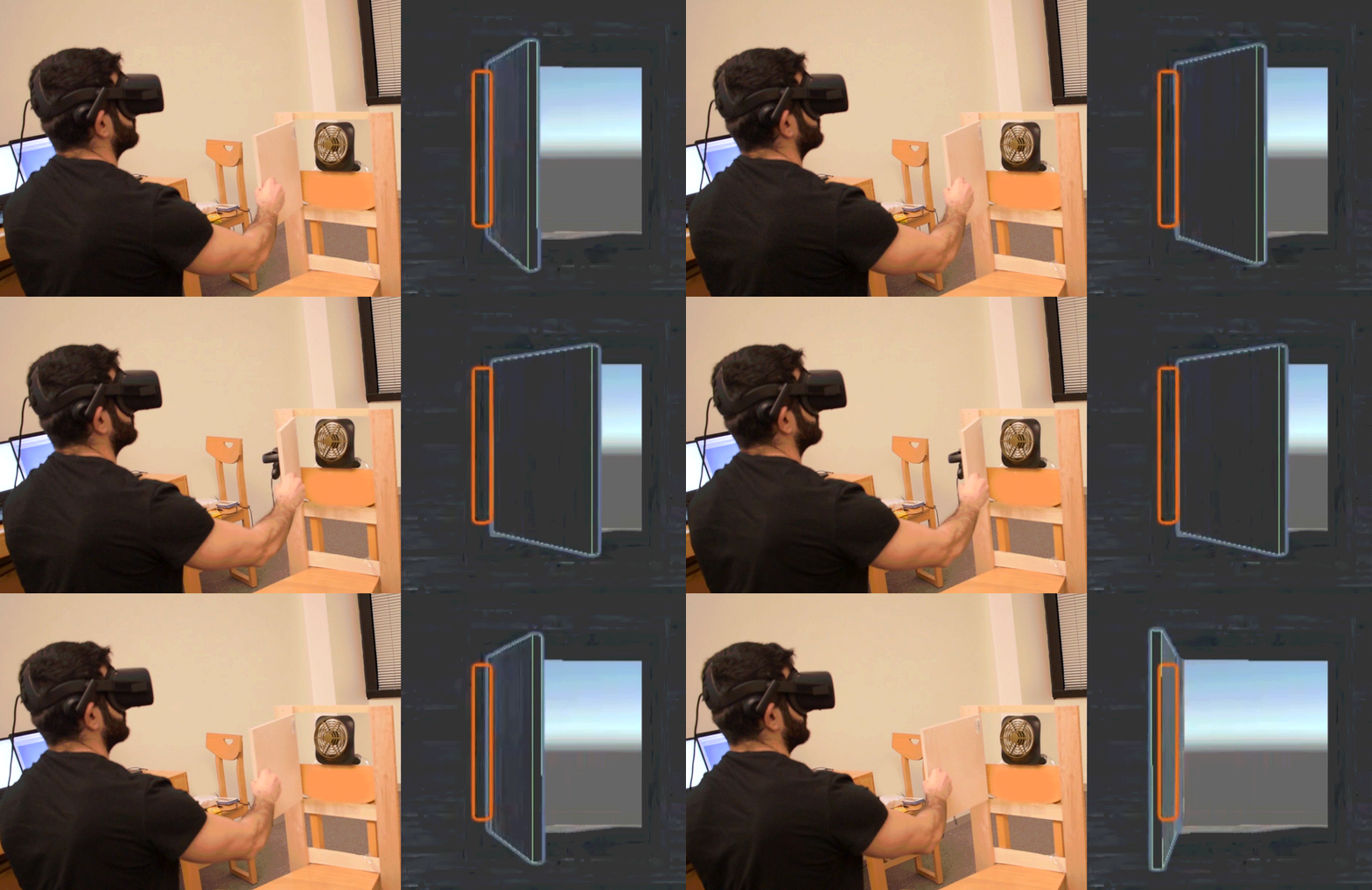
Physical World
Virtual World
I built a small, low-fidelity window prototype using readily available materials to test the physical interaction. Rather than developing a complex 3D environment for the virtual platform, I created a simple digital representation, as the primary objective of the experiment was to investigate how a physical object could be synchronized with its virtual counterpart.
To achieve this, I used an Oculus Rift controller as a physical object tracker, securely attaching it to the prototype. This allowed the system to track the window’s position and movement and mirror the interaction within the virtual environment, establishing a direct connection between the physical and digital experiences.
Testing Virtual Environment
For this experiment, I reused the low-fidelity physical prototype and created a new virtual environment in Unity—a room overlooking the ocean. I wanted to explore whether a familiar, home-like setting could help counter the confined and highly controlled environment of the space station, giving astronauts a sense of connection to the everyday experiences they miss on Earth.
Physical World
Virtual World
Nature and Everyday Activity Aboard Spaceship
Physical World
Virtual World
This experiment explored a new scenario in which astronauts remain within the physical interior of a spacecraft while using VR to transform the view outside the window. Through the headset, the spacecraft interior remains unchanged, while the window view shifts from the vacuum of space to an interactive nature scene.
To improve the physical interaction, I built a new prototype with a larger window and a larger fan, allowing the user to more effectively experience the simulated environment.
Creating Final Experimental Physical Prototype

Sensum explores how nature and familiar everyday experiences can be recreated within the confined environment of a spacecraft. By combining VR with wind, sound, scent, and a physical window, the project creates an immersive multisensory experience that brings astronauts closer to the familiar sensations of Earth.

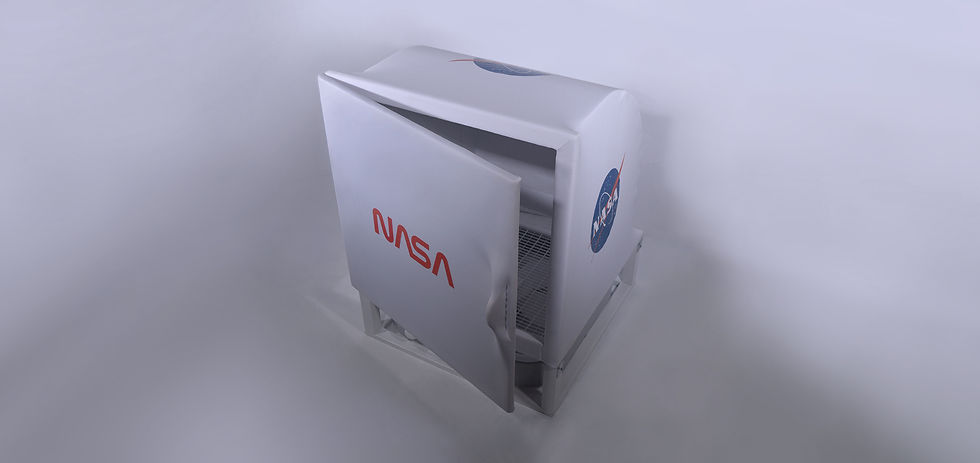
Experimental Prototype

Features
Winds


Smells

Virtual Environments
Forest


Winter Mountain


Beach/Ocean


Lake


Scenario
Choose the environment you want to experience
Forest

Beach/Ocean

Winter Mountain

Lake

Choose the smell corresponding the environment

Experience

Place the smell tube
Wear the VR headset


Projects


