
SENSUM
For the last 20 years, the International Space Station (ISS) has been running by different astronauts who had to live in a new environment that is completely different than where they used to live before. Since they live up there for at least 6 months, one way or another they start missing any earth-like experience during that time they spent in that confined environment. Sensum is an experimental project that explores potential solutions to deal with this issue for astronauts aboard the ISS, as well as for those who will be gone for Mars one day, by exploring some ways of simulating the elements of nature and everyday activities in the zero-g environment in a way utilizing virtual reality technology (VR) and physical objects that work altogether.
Background
This is the International Space Station where the astronauts live for months and stay away from everything on Earth. It carries a crew of up to seven people and has a habitable volume of 13,696 cubic feet that comprises of 16 pressurized modules.

The interior of each module more or less looks like in the images below. During the day, the station crew spends their time inside these modules to work on science experiments that require their inputs, as well as ensuring the maintenance and health of the orbiting platform.


What Do They Say?
During the research phase, I pulled up some interviews that were done with different astronauts by different people. When they asked the astronauts what they miss most about the Earth, the things they mostly mentioned ranged from waves, wind, rain, smell, and sound of nature to traffic noises and other normal everyday activities back home.
Mikhail Kornienko (Russian Cosmonaut);
“The technology on the ISS definitely tires you and most of it is psychological. You literally miss everything. You literally miss everything. All the normal everyday activities that you don't often value on Earth become the most important things up there.”

Terry W. Virts (Former NASA Astronaut);
“One day I was floating down to middle of the station and heard this bird chirping and I saw Mikhail Kornienko was listening to the bird sound in the MP3 player that Russian psychologists sent him. It was so awesome to hear birds and everybody wanted this MP3. We had rain, waves, street traffic noises, we had cafe where you hear people chatting, glasses clicking etc.

Scott Kelly (Former NASA astronaut);
“You're missing the weather. There's no sun on your face, you never feel the heat coming from the fire, you never feel cold breeze but it's always exactly the same in space.”


Tim Peake (Former ESA astronaut);
“The rain, it’s something that you don’t
feel up there. Obviously you don’t feel
any weather, so any weather down here
whatsoever feels unique and it feels
very special.”


Kate Rubins (NASA Astronaut);
“I have heard from a lot of other people, that funny enough, they miss the weather. They miss things like rain, they miss the
smell of earth, they miss wind... We’ll be
looking forward to getting back to that when we come home.”
Christina H. Koch (NASA Astronaut);
“Oh, how I miss the wind on my face,
the feeling of raindrops, sand on my
feet and the sound of the surf
crashing on the Galveston beach. We
take daily sensory inputs for granted
until they are absent. I cannot wait to
feel and hear Earth again.”

Mission Statement
Explore ways of simulating nature and everyday activities aboard the spaceship to make the astronauts feel connected the earth-like experiences when they get bored with the unnatural and confined environment of the spaceship.
The Way I Explore

Physical Objects

Virtual Reality

Wind

Sound
Smell
Starting Off With Sketches
In the idea exploration stage, I started to sketch out some potential scenarios that are meant to apply to both the virtual and real world in such a way that the user will be interacting with both simultaneously. The main inspirations for all the ideas I explored here derive from the facts that the astronauts start missing both the everyday activities that they used to do on Earth and the elements of nature such as being into the woods, feeling the wind, smell, rain, hearing the sound of Earth, being at the beach or oceanside etc. Taking into account all these valuable parameters, I started off with generating as many ideas as I can in order to be able to reach out to the most promising ones to move on to the next steps.

Experiments
Among the ideas above, being able to feel the wind and an everyday activity, which is to open a physical window and look outside, were the most promising ideas to continue with and do experiments on because they had a huge potential to respond to the things the astronauts miss most about the Earth.
Syncing Up
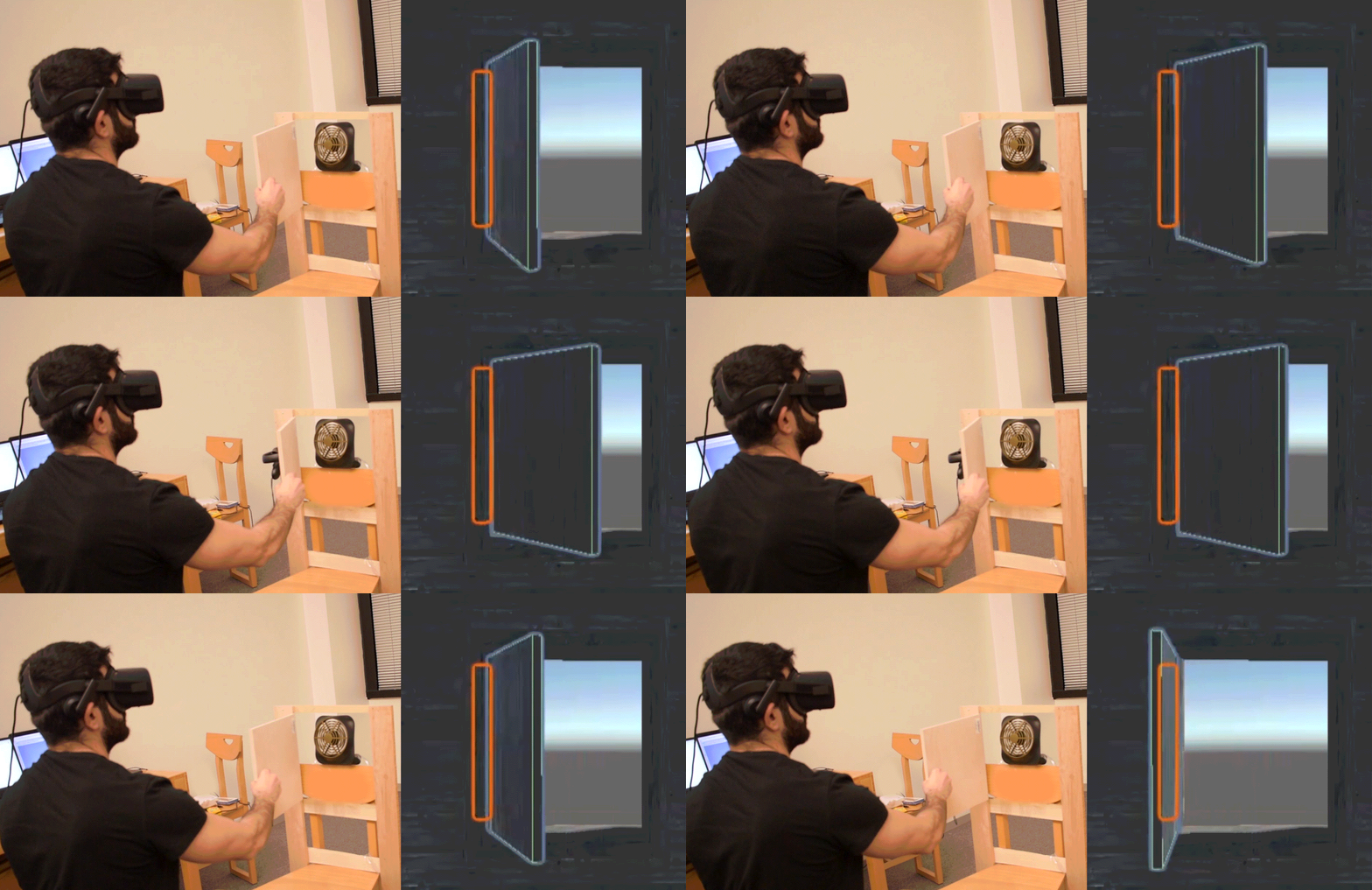
Physical World
Virtual World
I made this small window out of low fidelity material. For the virtual platform, I did not build a complicated 3D asset but something very simple since the main purpose of this experiment was to learn how to sync up the physical object with the digital representation of it in the virtual platform in which I used one of the controllers of Oculus Rift as a physical object tracker and tied it to the physical object.
Testing Virtual Environment
For this experiment, I also used the low-fidelity prototype that I made before. However, this time, I created a new virtual environment, a room with an ocean view, by using Unity. The reason why I wanted to create this environment is that since the astronauts live the sophisticated and confined environment of the space station and these are the only things that they interact with and see every day for months. I thought building an environment that has home-like ambiance would help them feel a little closer to their home or normal life back on Earth since this is among the things that they miss while spending their time in space.
Physical World
Virtual World
Nature and Everyday Activity Aboard Spaceship
Physical World
Virtual World
This experiment was done to try out a new scenario in which you are in a spaceship environment where you see from the spaceship’s window the outside is the vacuum of space. Once you wear the headset, you will be still seeing the exact same interior environment of the spaceship through the VR headset, however, only difference will be that the window view turns into a nature scene which you will be able to interact with to some extent. So, I made a new prototype where I used relatively a bigger fan and a bigger window than the previous one to be able to interact better.
Creating Final Experimental Physical Prototype
.jpg)
On the ISS, there is no way for the astronauts to open a window and look outside as we do at our homes here, on Earth. Sensum is an experimental project that is meant to simulate the ways of experiencing nature and some everyday activities in the confined environment of spaceship. Being able to open a window, look and enjoy outside by utilizing VR, smell, wind, and sound is the main idea to get some earth-like experiences on the spaceship environment.

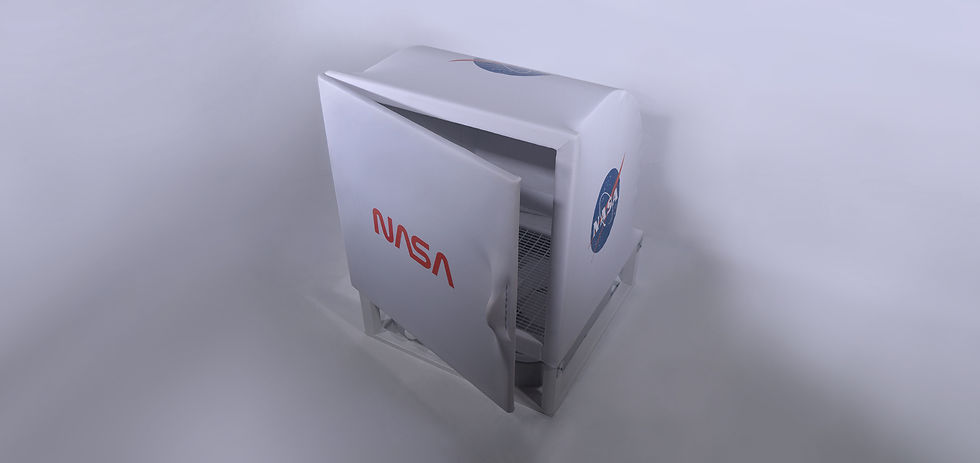
Experimental Prototype
After many makings and tests, I have been able to make a final prototype that is not meant to be a final product but an experimental prototype reflecting the outcome of my journey so far. This prototype is a more advanced version of the previous one that works with the same principles. However, in this one, there are also sound, smell, and wind temperature features included in a way that all these features differ from the environment that you would like to experience. For example, in this experiment, the person is in a spaceship both physically and virtually and that is why she hears the sound of the spaceship in the opening. As she wants to experience a forest scene through the window, as soon as she opens it, the audio changes to the sound of that forest scene, as well as she is able to smell the forest and feel the warm wind as if it comes from the real nature.

Features
Winds


Smells

Virtual Environments
Forest


Winter Mountain


Beach/Ocean


Lake


Scenario
Choose the environment you want to experience
Forest

Beach/Ocean

Winter Mountain

Lake

Choose the smell corresponding the environment

Experience

Place the smell tube
Wear the VR headset


What's Next?
This is an ongoing project that I have collaborated and been advised with talented designers from NASA, Skye Ray, and MIT Media Lab, Xin Liu, as well as professors at RISD, Peter Yeadon, Agatha Haines, Michael Lye, whom I have learnt many hidden information in the realm of designing for space. For the next steps, I would like to improve both virtual and physical prototypes further in such a way that they would be more feasible and compact, and have a real astronaut test it to get valuable feedback.